
Created by Marisa Chearavanont, wife of CP Group’s chairman, the Khao Yai Art Forest includes works by Louise Bourgeois and Richard Long.
In 1999, the late French artist Louise Bourgeois unleashed her Maman, one of the most recognised and fearful symbols of motherly love in art. The metal sculpture of a female spider nine metres (30 feet) tall was a tribute to her own mother – a tapestry restorer who died young and who, in the artist’s mind, had an arachnidan knack for patching what was broken. Today, a bronze version of Maman, on loan from the artist’s Easton Foundation, sits above a paddy field just outside Thailand’s Khao Yai National Park. The park, Thailand’s oldest protected reserve, is a place many people visit to escape the smog in Bangkok – about three hours away by car – and reality.
Visitors on their way to the park might pass the nearby Toscana Valley – an Italian-themed resort with a replica of the Leaning Tower of Pisa and, even more bizarrely, Wild West ranches filled with Thai cowboys and country music. But the newly opened Khao Yai Art Forest, where Bourgeois’ spider looms, is far less exotic. According to its founder, it is a sanctuary where land will be restored to its natural state and where art and organic food can inspire visitors at a time of destructiveness and divisiveness. “Everything’s fast changing and there is a lot of [imbalance] in the environment,” Marisa Chearavanont says. “We have to heal ourselves and I want to heal with art.” The 61-year-old grandmother bought this 65-hectare (161-acre) farm plot after discovering the restorative power of the adjacent Khao Yai National Park during the pandemic, when she stayed in her family’s country home nearby. Born Kang Soo-hyeong in South Korea, Chearavanont was described by the Bangkok Post newspaper as “quite a new face in Thai society” in 2020, just after she moved from Hong Kong, her home for 21 years.
There would have been a great deal of curiosity and scrutiny since she is the wife of Soopakji Chearavanont, chairman of his family’s Bangkok-based business empire, the Charoen Pokphand Group (CP Group). It has often been said that the CP Group is not just one of Thailand’s biggest business conglomerates, but the conglomerate. The billionaire Chearavanonts are the wealthiest people in the country (excluding the king) and the second richest family in Asia, behind the Ambanis in India, according to Bloomberg. The CP Group generated US$98.4 billion in revenue in 2023 from eight diverse business lines, including telecoms, property, retail and agriculture. That the group is one of the world’s largest producers of feed and livestock has made it a target for clean air campaigners. Smallholders in Thailand, Laos and Myanmar who supply the group and other agribusinesses regularly burn their fields to increase yield. Despite voluntary programmes such as CP Group’s “No Mountain, No Burning, We Buy” corn-tracing scheme, the situation remains dire, especially during the spring “burning season” in Northern Thailand. Thus, the February 2-3 opening ceremonies of the Khao Yai Art Forest, which stands on land depleted by serial monoculture, bore some semblance of a merit-making exercise.
Invited international press – including the Post and VIPs such as Korean star Lee Min-ho and the chairman of Thailand’s National Soft Power Development Committee – arrived through the “Flat Land Reception Area” with its stunning, thatched roof pavilion and gigantic round table for community events. Leading the way under the blazing sun was the besuited, urbane Italian architect and curator Stefano Rabolli Pansera, founding director of the non-profit foundation Khao Yai Art. Pansera, whose varied career includes founding a non-profit organisation that engaged in experimental urbanisation projects in Africa and Europe, met Chearavanont when he was working as an art dealer at the gallery Hauser & Wirth. Chearavanont, a patron of London’s Tate Modern, New York’s New Museum and Hong Kong’s M+, once gave a painting by Salvador Dalí to her daughter as a birthday present and is known to be a major collector, though she downplays the size of her collection and says it is not the focus of the foundation. A few years ago she bought a number of abstract sculptures by major artists such as Richard Long and Richard Nonas from the Panza Collection – of Italian collectors Giuseppe and Giovanna Panza – through Pansera, who was then still a director at Hauser & Wirth.
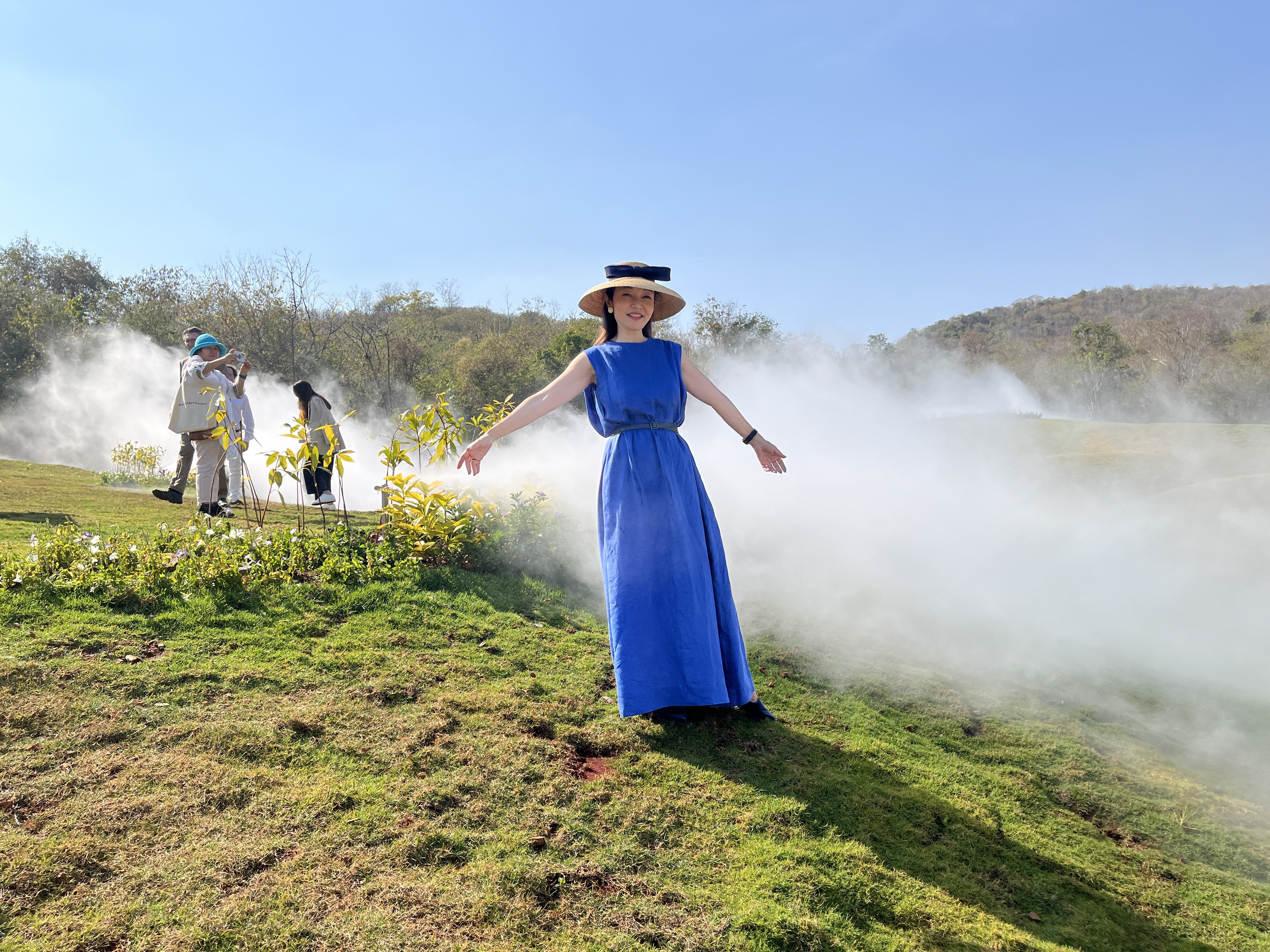
Long’s 12-metre-wide Madrid Circle (1988) now sits on a hilltop in Khao Yai. Made with slate slabs, it is one of several monumental outdoor installations along a trail open to the public as part of a ticketed tour costing 500 baht (US$15). Other ticketing options are available for visitors, including free entry to the Flat Land Reception Area and the site of Maman. As Pansera explains, site-specific commissions such as Thai artist Ubatsat’s Pilgrimage to Eternity (10 fragments of stupa made from local soil) and Francesco Arena’s GOD (two engraved granite stones stacked on top of another) are also in the spirit of the land art movement to which Long belongs. The movement emphasises materials of the Earth and works are often placed distant from population centres. Given time, nature will erode or engulf the works as the artists intended. Visitors can also sign up for a lunch or dinner made with local ingredients, designed by young chefs trained through Chearavanont’s other passion project, the foundation Chef Cares. During the opening, guests feasted at the long “Forest Table” in front of the site of Japanese artist Fujiko Nakaya’s Khao Yai Fog Forest. The 91-year-old pioneer’s new work is activated three times a day for 20 minutes each time. At the press of a button, artificially created fog made with sustainably generated atmospheric water rolls down grass slopes landscaped by Nakaya’s frequent collaborator, Atsushi Kitagawara Architects. If not for the fresh turf, the scene bore an alarming resemblance to smoky, burning hills. In fact, the mist will help create lush terrain over time, Pansera said, with a pleased Nakaya looking on.
Later, Buddhist monks from a nearby temple gave their blessing to the land, looking cinematic in their orange robes as they emerged through the thick fog and moved in single file towards Maman. All this had nothing to do with the CP Group, Chearavanont said. There is a token amount of sponsorship from the company – she did not divulge specific amounts – but the art forest is hers alone. She was born fearless, she said, and “Korea was too small for me”. Her hunger for adventure took her to the US, where in the 1980s she became the first woman from Korea to attend New York University, she said, from where she was exposed to the city’s exciting art scene. After she married, she opened an art gallery in Hong Kong, but after having her first child, her in-laws urged her to close the business and focus on being a stay-at-home mum. For a long time, she was a mother, wife and daughter-in-law. “But now my four children have all grown up. Now it’s my own chapter. Maria Chearavanont’s chapter. This is what I can do.” The urge to heal prompted Chearavanont to buy another damaged property in 2023 – a sprawling cluster of Brutalist buildings that used to be the headquarters of Thailand’s largest textbook printer, located on the edge of Bangkok’s Chinatown. The buildings, while structurally safe, were abandoned after a fire around 20 years ago.
In 2024, she reopened the site as Bangkok Kunsthalle, an extraordinary space designed for temporary exhibitions and film screenings. The low-intervention approach evident in the art forest is applied here, too. Damage from the fire has been left as it was, the rooms are mostly unlit, broken glass windows remain and there is very little air conditioning. Healing, here, is not through gentrification. There is enough of that in other parts of Bangkok’s Chinatown, Pansera said. Here, healing is helping the neighbourhood’s history emerge, and for there to be a space where artists and curators from all over the world can work together. Healing here is also being applied to a monumental monochrome diptych by the late Thai artist Tang Chang. Tang’s family have lent a beautiful collection of his abstract, calligraphic works on paper for an exhibition in the Kunsthalle curated by Mark Chearavanont – the only one of Marisa’s children pursuing a career in art. In a win-win exchange, the Kunsthalle has arranged for specialists from Bangkok’s top art restorers, Restaurateurs Sans Frontières, to clean and stabilise the badly damaged diptych on the floor above the exhibition.
Chearavanont also helped bring about the inaugural Access Bangkok art fair in 2024, which was organised by two Korean art businesses. She was also seen accompanying the country’s new prime minister, 38-year-old Paetongtarn Shinawatra, as the latter spread the word about Thailand’s “soft power” at the World Economic Forum in Davos, Switzerland, in January. As the government is busy telling the good story of Thailand, there does appear to be plenty happening in Bangkok’s art scene, albeit mostly funded by the private sector. The Dib Bangkok Museum of Contemporary Art, brainchild of the late collector Petch Osathanugrah, is set to open later this year. Retail giant Central Group is said to be planning a major art space of its own in a renovated warehouse. Meanwhile, the Bangkok Art Biennale, which is overseen by its spirited founder Apinan Poshyananda and supported by drinks company ThaiBev, just keeps expanding. This year’s edition, which ends on February 25, included the National Gallery and the National Museum among its citywide venues for the first time. And in January, Chanel flew film star Tilda Swinton to Bangkok to perform at the well-received Bangkok Experimental Film Festival, headed by artist-filmmaker Apichatpong Weerasethakul.
For all the government’s talk of promoting Thai culture, there remain few public resources dedicated to the arts, says Manit Sriwanichpoom, one of the country’s best-known artists. Pojai Akratanakul, a curator for the Bangkok Art Biennale, says there has been growing interest in contemporary art from private entities over the past decade. “This support has become crucial for developing the local art scene, especially given the limited public funding. It has been particularly important in creating jobs and opportunities not just for artists but also for art workers, which allows the ecosystem to expand much faster.” Chearavanont says she has big hopes for Thailand’s cultural sector, but her main driving force is a desire to leave a positive legacy. “Many people ask, why create this? I don’t want to create something that already exists. At this age, I want to make something nobody else has done.”
'https://www.scmp.com/lifestyle/arts/article/3299403/ex-hong-kong-gallerist-buys-thai-forest-healing-art-project'>Enid Tsui