When Wilson Ng left Hong Kong in 2006 to study music in Europe, he was a 16-year-old flautist who was not particularly interested in music written by Asian composers, nor did he feel any special connection to their work.
“I played a lot of contemporary music,” Ng says. “But whether the pieces were by Asian composers or not never mattered to me.”
Today, 35-year-old Ng, one of the most successful Asian conductors of his generation, cannot feel more different.
“I feel like a lot of people in Asia...
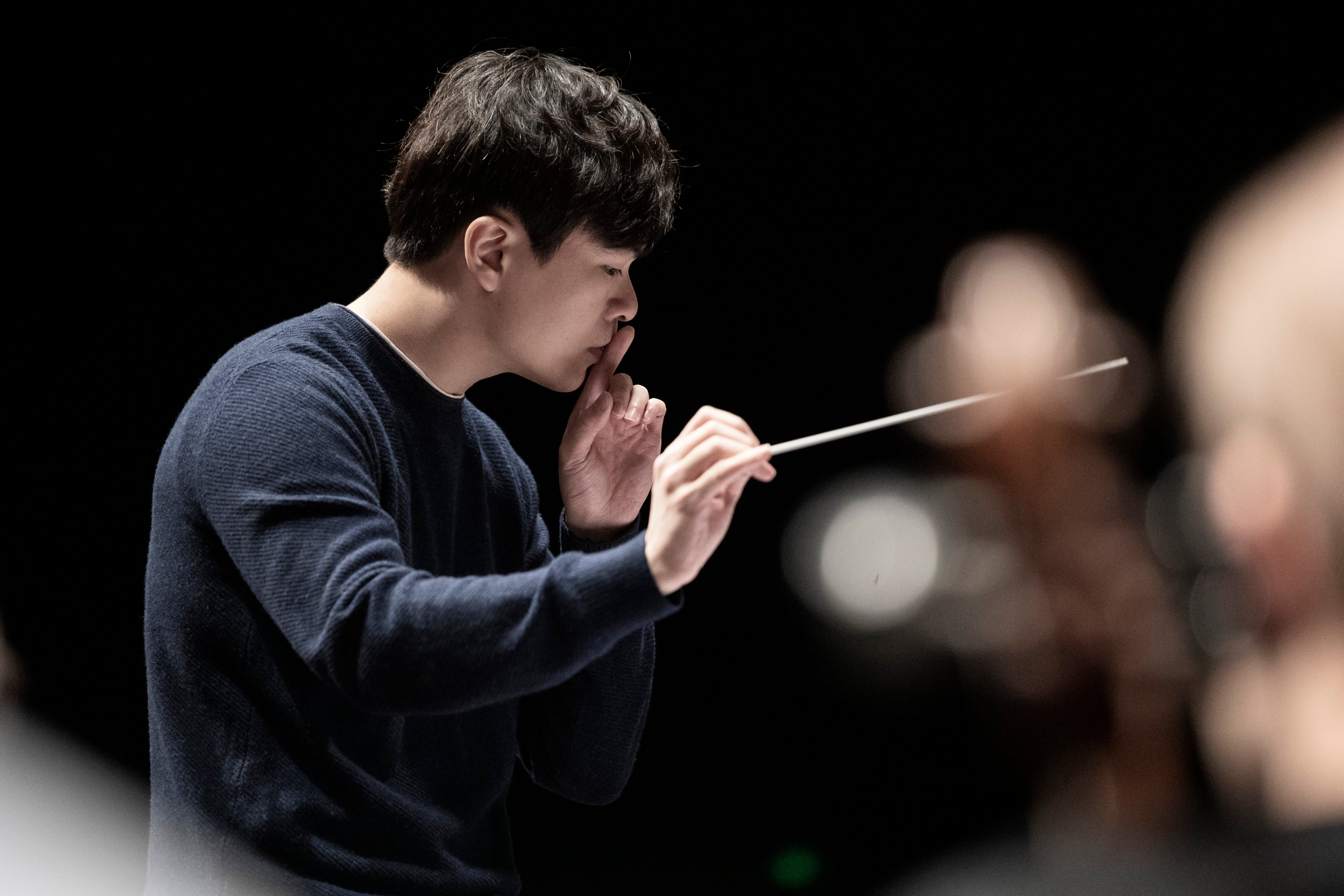
When Wilson Ng left Hong Kong in 2006 to study music in Europe, he was a 16-year-old flautist who was not particularly interested in music written by Asian composers, nor did he feel any special connection to their work.
“I played a lot of contemporary music,” Ng says. “But whether the pieces were by Asian composers or not never mattered to me.”
Today, 35-year-old Ng, one of the most successful Asian conductors of his generation, cannot feel more different.
“I feel like a lot of people in Asia have no idea that we have something unique and special to give in terms of classical music,” Ng says.
He feels so strongly about raising awareness of works by Asian composers that he recently founded an orchestra based in Hong Kong: the Asian Modern Symphony Orchestra (AMSO). Its mission is to create programmes with distinct Asian flavours and showcase them with Asian musicians.
“Through AMSO, I wish to bring our story to the world, invite everyone to get to know Asian composers and, through their music, raise curiosity for our culture and history.”
Ng says his initial interest in Asian compositions was sparked when he was in Europe studying the flute and conducting.
Despite living in culturally diverse cities like Paris, Berlin, Glasgow and the Swiss city of Lausanne, he often faced scepticism about how his Asian background could thwart deep connections with works by European composers.
He spent years immersing himself in European languages and culture to counter such remarks, and even became more comfortable conversing in French than in Mandarin. Still, the barrier remained.
“Even today, there are still people who describe [some of] the world’s best musicians, who happen to be Asian, as technically perfect, but not truly understanding the emotions behind the music because they don’t get the cultural background,” he says.
Ng says opportunities to develop ties with other cultures in Asia, outside his native Hong Kong, brought him fresh perspectives.
In 2019, he became the youngest-ever associate conductor at the Seoul Philharmonic Orchestra, one of Asia’s top professional ensembles. Four years later, he became the principal guest conductor of the Hankyung Arte Philharmonic, another prominent orchestra in South Korea.
View this post on Instagram
A post shared by Asian Modern Symphony Orchestra (@asianmodernsymphony)
At the same time, in 2019, he started taking part in the Beijing Modern Music Festival, a festival founded by Ye Xiaogang – one of China’s most prominent living classical composers – which showcases contemporary compositions from the region. Ng has conducted the opening and closing concerts of the festival on four occasions since.
“The perspective I gained from working in Asia is that the culture is extremely rich, there are many stories to tell and many composers creating great musical pieces. More could be done in terms of bringing them into people’s awareness.”
The biggest inspiration that prompted the creation of AMSO came when Ng pivoted his career back to Europe last year and witnessed the nurturing environment for composers and orchestras there.
In 2024, he was named the recipient of the Edo de Waart assistant conductorship at the Netherlands’ Radio Philharmonic Orchestra. This year, he was named a conducting fellow at the London Philharmonic Orchestra.
In the Netherlands, he saw how Dutch composers received overwhelming support from the Dutch government and orchestras, something that he felt could be emulated in Asia.
“It’s simple: if you don’t focus on supporting and promoting your own composers, no one will.”
The arrival of AMSO can help solidify Hong Kong’s position as a platform for Asian music. The Hong Kong Philharmonic Orchestra, the Hong Kong Sinfonietta and the Hong Kong New Music Ensemble have for years been commissioning local composers as part of their mandate to support the city’s musicians.
Ng says that AMSO can further assist by promoting music from across the whole region, not only for the sake of today’s musicians and audiences, but for posterity.
“Only by having enough people doing it enough times would we be able to know what pieces have the potential to go down in history.”
All of his experiences have led him to his current mission: to fully embrace his identity as an Asian conductor and to actively support and perform works by Asian composers.
Similarly, identity is a factor some composers deem to be one of the most significant influences in their creative process. Such is the case for Ye, the 69-year-old Chinese composer.
Ye is, along with Academy- and Grammy Award-winning Chinese composer Tan Dun, among a wave of composers from mainland China who were educated at the country’s Central Conservatory of Music after the Cultural Revolution (1966-1976).
He graduated from the conservatory in 1983, and since 1994 has taught composition there. He served as its vice-president from 2009 to 2018.
Ye’s works have unmistakable Chinese cultural and historical touches – from titles such as The Macau Bride, Cantonese Suite and Mount Emei, to melodies that sound distinctly Asian. His works are well-received, and there are nearly 20 concerts playing his pieces this year.
“Throughout my career,” Ye says, “my methods have been more or less influenced by traditional Asian music … I tend to express my musical ideas through a very Chinese musical language, but through modern compositional techniques.”
Chan Hing-yan, a prolific Hong Kong composer and a music educator of 27 years at the University of Hong Kong, has also been creating distinctly Asian-sounding harmonies for decades, masterfully integrating Chinese instruments with Western orchestras.
His ability comes from his background of being an erhu player since secondary school, and studying Western composition in Hong Kong and in the US, which resulted in a profound understanding of both musical traditions.
Chan believes that Asian composers enrich the classical music repertoire, and not merely through using Asian instruments.
“There are composers from Asia that sound so profoundly different from the West, like Toru Takemitsu. You can feel the Japan-ness, but it’s not the kind that is very superficial. He used the Japanese elements in a very philosophical way, but at the same time in a very, very subtle manner,” Chan says.
“You feel the silence, the way he handled it – it’s very different from European composers. It sounds so unique that I can’t think of anyone from the European continent who did something like that.”
Chinese composers from Ye’s generation who were trained at the Central Conservatory also have their own voices, Chan said.
“A lot of these Chinese composers used raw materials from the villages and remote tribes in China. It was very fresh for the European audience.”
But Chan stresses the danger of orientalising and exoticising oneself too much as a composer from Asia. If the “Asian elements” are incorporated in a superficial way, it not only lowers the quality of the work but also contributes to stereotyping Asian composers.
With that being said, Chan can see the tendency for composers from the region to be pigeonholed into creating “Asian-sounding” music – often against their creative ambitions – for various reasons, such as audience expectations and the need to sell concert tickets.
Composers from the region crave opportunities to create music freely, Chan says. For that to happen, art administrators should be more open-minded, and there should be public interest and support. Multiple institutions co-commissioning pieces will also help.
“There are many great composers in Hong Kong, such as Charles Kwong, Daniel Lo and Angus Lee … but being a full-time composer is not an easy nor realistic feat,” Chan says.
Ultimately, good music shines through, Chan says – and with the internet, composers have a platform on which they can showcase their work to the world with a click of a button.
Ng agrees with Chan that, in the end, there is only good music and bad music.
“I don’t think we need to continuously think, ‘Oh, this music is Austrian, French or Asian,’” he says.
But he admits that, at the moment, doing so might be necessary to drum up support and raise awareness about what Asian musicians can uniquely contribute. He hopes AMSO will be able to carve out that space for Asian compositions and musicians to shine.
In AMSO’s premiere concerts at the Hong Kong Cultural Centre, the orchestra will play programmes that blend pieces by classical composers such as Ravel and Tchaikovsky with contemporary works by Asian composers like Ye Xiaogang, Hong Kong’s So Ting-Cheong and Korea’s Unsuk Chin.
Seventy-three musicians from across Asia will join hands to create harmony. Star pianists KaJeng Wong and Bruce Liu will perform as soloists.
Ng hopes the Hong Kong audience will pay special attention to the piece by So.
“So is one of my favourite composers from Hong Kong. I find his personal journey deeply moving. He actually retired from composing over a decade ago, saying it was ‘too difficult’ to pursue this. But I see him as a true genius.
“The piece we’re performing is an early work, written when he was still young – and yet it shows remarkable maturity. It leaves me wondering: what more could have emerged from him if he had received more support and encouragement? His music deserves to be heard.”
“KaJeng Wong X Wilson Ng” and “Bruce Liu Returns with Wilson Ng”, Asian Modern Symphony Orchestra Premiere Concerts, Hong Kong Cultural Centre, Concert Hall, July 31 and August 1, 8pm. Tickets available from Urbtix.
