
While analysis can organise what we know; imagination helps us respond to what we did not know enough to anticipate, writes Ashoke Agarrwal The post Strategy & Creativity: The Art & Science of Growth appeared first on MxMIndia.
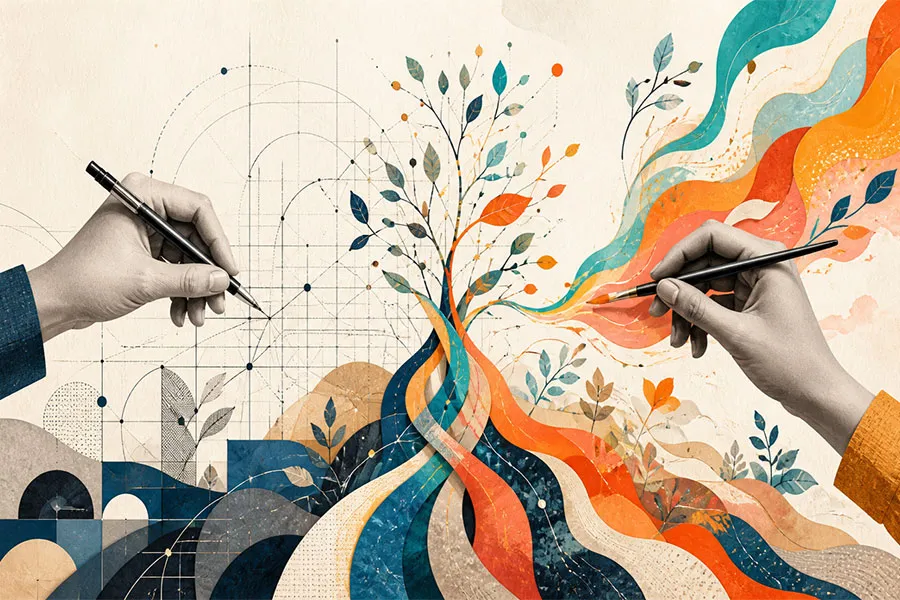
Abstract: Growth rarely emerges from strategy or creativity alone. It takes shape through a continuing conversation between discipline and imagination, analysis and intuition, continuity and change. Drawing on experiences in advertising, fitness, writing and entrepreneurship, this essay argues that strategy gives aspirations structure while creativity keeps them responsive to reality. The same dynamic applies to businesses and nations: Kodak’s hesitation, Netflix’s reinvention, India’s 1991 reforms and its digital public infrastructure all reveal the need to revisit assumptions without abandoning purpose. Planning matters not because plans endure, but because it prepares us to adapt. Meaningful growth-personal, corporate or societal-therefore depends on preserving this productive tension and continually asking what to retain, what to rethink and what possibilities have yet to be imagined.
When I was an account planner in advertising, there was a clearly visible line between strategy and creativity.
The client’s brand manager, the agency’s account manager and the planner would first wrestle with the business problem. What were the commercial and marketing objectives? What did consumer research tell us-and what might it be concealing? Where was the brand positioned, where could it credibly go, and what stood in its way? We would distil all this into a creative brief and hand it to the creative team.
What happened next often depended on the maturity of the creative person.
The senior, more evolved creative people usually spent considerable time discussing the brief with the planner. They questioned its assumptions, explored the consumer insight and sometimes helped reformulate the problem itself. They appeared to understand that the brief was not a set of commandments but the beginning of a conversation. Strategy could inform the creative work; the creative process could, in turn, expose inadequacies in the strategy.
The more callow creative person was inclined to accept the brief, retreat into a shell and emerge with “the creative”. Having developed the solution in solitude, he or she was ready to be wounded-and prickly-at the first sign of evaluation. Discussion felt like interference and criticism like rejection.
Over the past two decades, I have found myself returning to this old agency dynamic. I have thought about it while considering my own evolution, the growth of people I love, the businesses with which I have been involved as founder and consultant, and-perhaps inevitably for a news junkie-the economic, political and social trajectories of countries.
I increasingly suspect that meaningful growth often emerges from a similar conversation between strategy and creativity: between discipline and adventure, analysis and imagination, continuity and change.
This is not a conclusion I arrived at by reading management books. My own life has provided some fairly persuasive evidence.
For many years, I was closer to being a couch potato than an advertisement for active living. Becoming a fitness enthusiast required strategy in its most unglamorous form: routines, targets, persistence and the willingness to turn up even when enthusiasm did not. Inspiration is an unreliable alarm clock.
But discipline by itself would probably have converted exercise into another duty to be endured. Creativity made it interesting. I had to experiment with activities, goals and routines; to notice what engaged me; to find ways of recovering from lapses without treating them as moral failures. The strategic part created continuity. The creative part kept the journey alive.
The transformation was not a straight line from indolence to virtue. There were negotiations, relapses, discoveries and revisions. Perhaps that is why it lasted.
Something similar occurred in my relationship with creativity itself. For most of my life, I was a voracious consumer of other people’s creativity-advertising, books, journalism, music, cinema and ideas. Consumption can feel like participation, particularly when accompanied by strong opinions. But appreciating a finished work and confronting an empty page are rather different experiences.
Becoming a creative person myself required more than waiting for inspiration. It needed a decision, a practice and a structure. The result is that I now have a book on the way. If creativity supplied the curiosity and the impulse to express, strategy helped turn scattered reflections into sustained work. The muse, I discovered, benefits from a calendar.
And now, in my sixties, I find myself working on a technology-driven start-up—hardly the most obvious station on a conventionally planned journey. Here too, strategy and creativity perform a kind of jugalbandi. Experience helps one assess risks, recognise patterns and ask whether an idea can become a viable business. Curiosity makes it possible to enter an unfamiliar technological landscape without pretending to know everything about it.
Age can provide strategy in the form of judgement. It can also harden into a strategy of avoiding embarrassment. Creativity asks us to risk being beginners again.
These experiences have made me less inclined to see strategy as a finished plan. Dwight Eisenhower once said, “Plans are worthless, but planning is everything.” The distinction is useful. A plan captures what we believe at a particular moment. Planning is the continuing process of testing that belief against reality.
Henry Mintzberg similarly distinguished strategic planning from strategic thinking. Planning is largely analytical: it breaks goals into formal steps. Strategic thinking also involves synthesis, intuition and creativity. In other words, analysis can organise what we know; imagination helps us respond to what we did not know enough to anticipate.
Businesses encounter this tension every day. Their plans necessarily contain assumptions about consumers, competitors, technology, regulation and culture-precisely the things that refuse to stay still.
Kodak is now routinely invoked as a cautionary tale because one of its own engineers developed an early digital camera. The company did not lack technical creativity. Its problem was bringing that creativity into a sufficiently searching conversation with a business strategy built around film. It could invent the future without quite being able to imagine itself living in it.
Netflix travelled in the opposite direction: from DVDs sent through the post to streaming and then to producing content. Each transition disturbed an existing success. Its evolution suggests that a business can remain focused on the need it serves while repeatedly reconsidering the means by which it serves it.
I am wary of turning either example into a neat business-school morality play. Corporate decisions are messier in real time than they appear in retrospect. Still, they remind us that numbers and imagination need not be adversaries. Evidence can tell us what is happening; it cannot always tell us what might happen next.
Countries face a more complicated version of the same tension. They need institutions, infrastructure and long-term priorities. They also need the ability to respond to shifts in technology, demography, climate, trade and geopolitics. The difficult question is not whether a nation should preserve its ethos or adapt to change, but what to preserve, what to reinterpret and who gets to decide.
India’s economic reforms of 1991 represented one such adaptation. The country did not discard its political identity; it revised an economic framework that had become inadequate to its circumstances. More recently, India’s digital public infrastructure has offered another interesting combination: public systems provide common rails and rules, while businesses and citizens devise uses that no central planner could fully anticipate.
But economic and technological ingenuity cannot be the whole of national growth. Political institutions, social relations and culture must evolve in conversation with them. In his final address to the Constituent Assembly, B.R. Ambedkar warned that political democracy could not last unless it rested upon social democracy—a way of life that recognised liberty, equality and fraternity.
His formulation seems particularly relevant because it resists growth in compartments. A society may become richer without becoming more equal, more connected without becoming more trusting, or more technologically sophisticated without becoming more open-minded. Whether that constitutes growth—or merely change—is worth asking.
Looking back, the best creative people I worked with treated the brief as neither scripture nor waste paper. They treated it as the start of a jugalbandi. The best planners, in turn, allowed the creative work to reveal possibilities and weaknesses in their strategy.
I now wonder whether something similar has helped me move from couch potato to fitness buff, from consumer of creativity to author, and from contemplating a quieter decade to working on a technology start-up in my sixties.
We need enough strategy to give our aspirations shape, and enough creativity to admit that our first idea of how to realise them may be wrong. The art—and perhaps the science—of growth may lie not in resolving the tension between the two, but in keeping their conversation alive.
Suggested Reading
Henry Mintzberg, “The Fall and Rise of Strategic Planning”, Harvard Business Review, January–February 1994. Roger L. Martin, The Opposable Mind: How Successful Leaders Win Through Integrative Thinking. Clayton M. Christensen, The Innovator’s Dilemma: When New Technologies Cause Great Firms to Fail. Tim Brown, Change by Design: How Design Thinking Transforms Organizations and Inspires Innovation. Ed Catmull with Amy Wallace, Creativity, Inc.: Overcoming the Unseen Forces That Stand in the Way of True Inspiration. Dwight D. Eisenhower, “Remarks at the National Defense Executive Reserve Conference”, 14 November 1957. B. R. Ambedkar, Final Address to the Constituent Assembly, 25 November 1949. World Bank, Digital Progress and Trends Report 2023.