
The brass ring on the door is the first clue that something has changed. No automatic sensor. No discreet sliding mechanism.
The brass ring on the door is the first clue that something has changed. No automatic sensor. No discreet sliding mechanism. Just a solid ring set into a metal facade, demanding that you press and wait for the door to be opened to let you in. It is a gesture that announces, before a single course lands, that this is dining as ritual. For chef-proprietor Vicky Lau, whose Tate Dining Room has embarked on its third major incarnation in Sheung Wan, this relocation is less a change of address than a complete distillation of her craft. After 14 years – first as a cosy 26-seat bistro on Elgin Street, then as a sprawling, pastel-hued institution on Hollywood Road with two Michelin stars – Lau has forged a new sanctuary that reflects her creative maturity. When she first walked into the former antique shop on Lok Ku Road, with its sweeping vertical volume and historic character, the potential was immediate. “When I walked in, I thought, wow, the ceiling is so high and beautiful,” Lau says. “My heart really wanted to stay in Sheung Wan … having your own style is actually quite special. And I have my own little ecosystem.” To translate her vision into physical architecture, Lau partnered with New York and Shanghai-based designer Chris Shao. “I saw his work and thought it was so beautiful,” she says. “Each project has its own style and uniqueness. Many small pieces aren’t just repeated over and over again; he always custom-designs them.” The design process was painstaking in its attention to detail. “When I had a meeting with him to design a chair, I was really tired afterwards because he gave us 200 materials to choose from for just one chair,” Lau says with a laugh. “But in the end, he only used eight materials for that one chair.”
Shao’s interior draws heavily from the textures of classical Chinese ceramics – incorporating cracked eggshell lacquer, tactile plaster finishes, custom ceramics and French textiles embroidered in China. Yet Lau’s personal touch governs every square foot. Lacking a corporate hotel backing or external project management team, Lau and her partner Romain Herbreteau personally oversaw the execution, often making day trips to Jingdezhen in China’s Jiangxi province to collaborate with ceramicists on custom stoneware. Across the main 22-seat ground-floor dining room and the eight-to-10-seat private room upstairs, natural materials take precedence over ostentatious luxury. Terracotta tiles from Jingdezhen, raw textured clay and dark charcoal wood give the interior a grounded, organic warmth. The design philosophy stems from a basic truth about human comfort: “Because people like nature,” Lau says. “Because we are from nature, we are most comfortable in nature.” The most striking feature of Tate 3.0 is not what has been added to the experience, but what has been intentionally removed. “I think now we’re actually reducing things rather than adding more,” Lau says. “I will question this. Is it meaningful to put it there?” She also made the decision to shorten the restaurant’s name from Tate Dining Room to Tate – a move towards minimalism.
Crucially, this third chapter introduces a Chinese name: tai di. Tai speaks to artistic form, personal demeanour and the delicate balance of the natural ecosystem, while di signifies a home, residence or grounded space. Together, they anchor two principles Lau holds supreme: cooking as an art form, and a profound reverence for the journey an ingredient takes from soil and sea to the kitchen. This philosophy of reduction touches every aspect of the restaurant, most notably the signature dessert presentation. At Hollywood Road, Tate was famous for its lavish 10-item dessert cart. Over time, however, Lau realised the display was encouraging performative social media documentation rather than genuine gastronomic enjoyment. “Many people came just for the cart to take photos. But I think it’s not my point any more, because I wanted a good last-minute moment that is memorable with many options and sweets to choose from. But then it became just about taking photos,” Lau says. “I put in so much effort to prepare 10 things every day, and the pastry team was really struggling. So now I’ve stripped it down … just three things, the most essential three things. I’m actually stripping down to what I think will work.”
A similar urge to streamline led to a redesign of service equipment. Rather than pushing loud guéridon carts through the dining room for tableside preparation, Lau and Shao built multi-tiered side tables that feature concealed drawers and sliding shelves. The hero of her new menu remains her iconic “Ode to Ingredients” series, which pays tribute to single ingredients such as crab, mushrooms, scallop and century egg. But the functional refinement extends to the main kitchen, which has been expanded with equipment, including a live lobster tank and a wok burner, to broaden Tate’s technical range. Lau’s evolving embrace of Chinese flavours mirrors a broader shift in Hong Kong’s dining scene. While combining French technique with Asian notes once met with local resistance, diners today actively seek authentic cultural integration. “There will be a bit more now … I still need to slowly immerse myself and figure it out,” Lau says. “People’s acceptance of Chinese culture has increased significantly.”
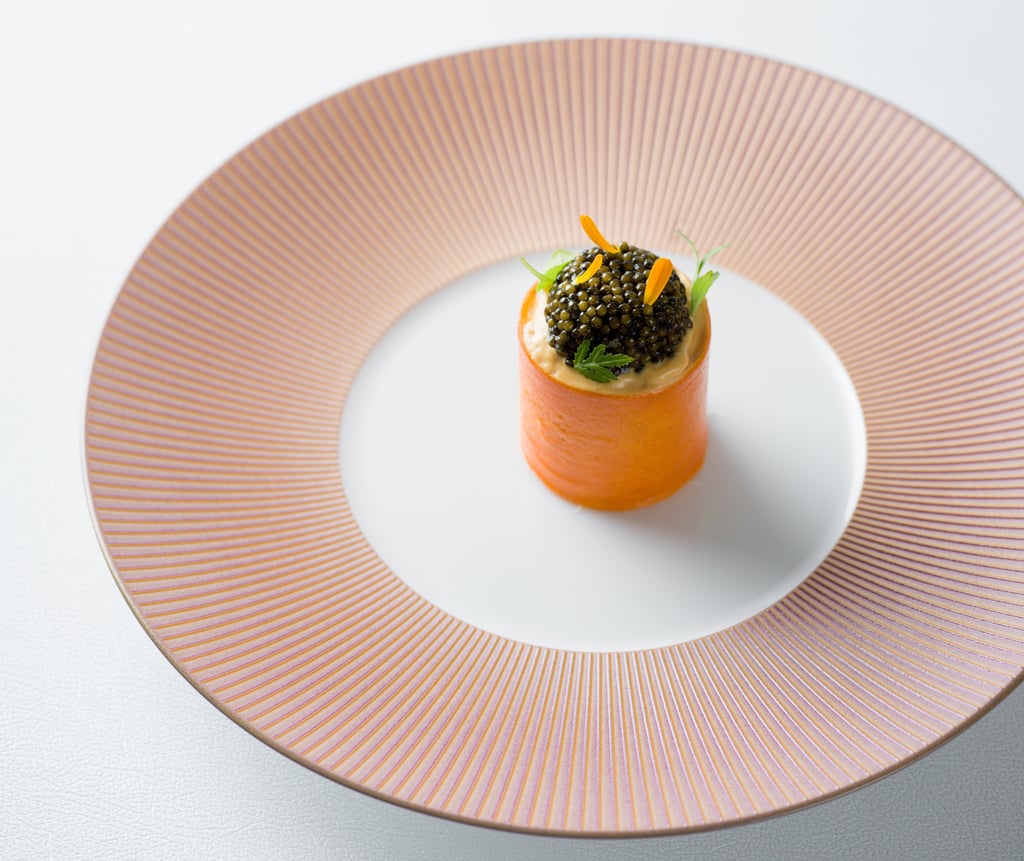
Beyond the kitchen walls, Lau has cultivated an extensive network of local and regional artisans. Over 20 independent craftsmen – ranging from ceramicists in Tai O to textile weavers and local tailors – contribute directly to Tate’s physical presentation. Custom dishware, such as the Linglong rice-grain porcelain, was commissioned directly from craftspeople in Jingdezhen, while speciality ingredients like wild mountain honey and medicinal herbs are brought in from Yunnan. For Lau, championing manual craft is an urgent antidote to the modern world’s reliance on mass production. “This is important because I think a lot of things nowadays are very manufactured. A lot of things are really mechanised. They’ve lost the human touch. So I think because our place is small, we can use it to do this kind of thing. So I source everything that is very artisanal. I really want to focus on this in the age of AI.” This focus on human effort extends to her management style. Today, Lau oversees an expanding portfolio that includes Tate; the soy-focused bistro Mora; Jija, a Yunnan-Guizhou-inspired concept; and An, a B2B soy products business. Managing venues in close physical proximity allows her to stay intimately involved without burning out.
Ultimately, Tate 3.0 represents a complete rethinking of what true luxury means in fine dining. For Lau, high gastronomy in 2026 is no longer measured by white tablecloths or formal rigidity, but by the space created for genuine human interaction. “I have always been seen as a chef, but actually what I want to do is really not just be a chef,” Lau says. Her background in graphic design and her hands-on approach to every detail – from interior lighting to custom ceramics – showcase an artist shaping an all-encompassing environment. As Lau’s culinary voice has matured, her confidence has solidified. The result is a restaurant stripped of unnecessary fluff, focused entirely on the guest’s comfort and emotional resonance. “In-person experience is a big luxury,” Lau says. “I think our role is really just to enhance the human experience because I think this is true luxury. Often at home, it’s just mobile phones, computers, watching movies. Sometimes we do not see our friends as well. So when we can really meet, how can we enhance these human touch things? I just want to facilitate people having a good experience.” Tate, 68 Lok Ku Road, Sheung Wan